We recommend signing up with your work email to keep all your marketing content in one place


Reading time: 3 min
Every marketing team asks the same question: do you test your ideas one at a time, or tackle ‘em all at once? Do you try a million different headlines for “buy our newest toothbrush!” or try two at a time and move forward iteratively?
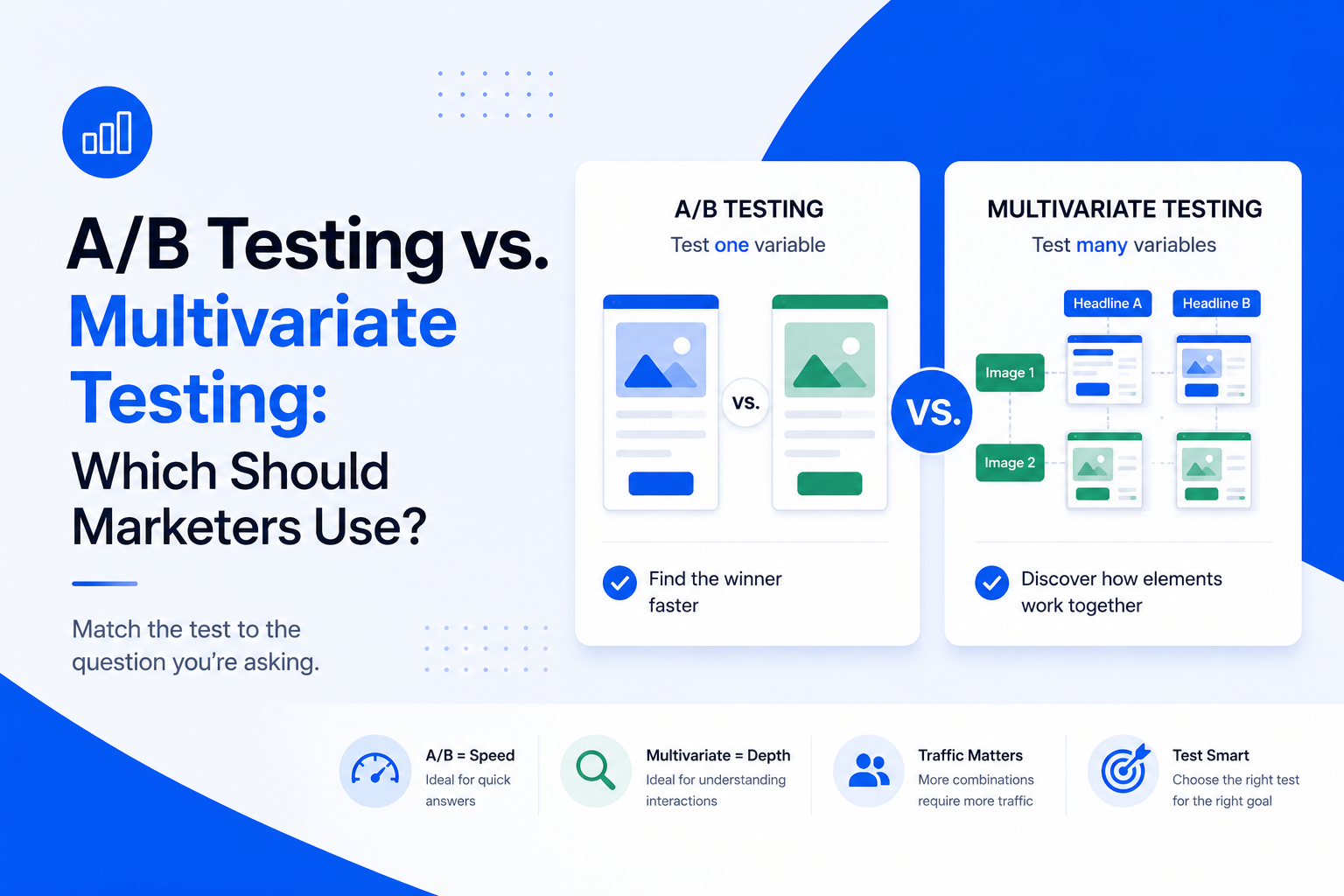
A/B testing changes one thing (a headline about dental health, a CTA that says “brush now”, an image of a smile) and measures which version wins.
Multivariate testing changes several elements at once, in every combination, so you see not just which headline wins, but which headline paired with which image paired with which CTA performs best together. You’re trying multiple permutations to see what combo works best
If you're asking "does this headline about toothbrushes beat that headline about gum health," go A/B. If you're asking "how do all these elements interact," then go multivariate.
Match the test to the fundamental question you want to answer.
A/B testing needs a decent sample size overall. Multivariate testing needs a decent sample size for each and every combination, and therefore needs a substantially larger traffic overall.
Test three elements with two versions each, and you've got eight combinations to fill. Double your traffic requirements and you're still nowhere near what a five-element test would demand.
Do the math on your traffic first. If you can't reach significance on each combination in a reasonable window, run sequential A/B tests instead.
A/B tests are fast to set up, fast to read, fast to act on. Multivariate tests take longer to design and interpret, but they show you something A/B can't: how elements interact. Maybe your bold headline only works with the minimal CTA “brush now!” and falls flat with the detailed one, “try our latest toothbrush!”
Use A/B when you need answers quickly. Use multivariate when you need to understand your copy as a system, and have the traffic to support it.
Multivariate testing is a high-traffic game. It belongs on your homepage or top landing page, wherever you've got volume to fill every combination without waiting a quarter for results.
Lower-traffic pages and new campaigns should stick with A/B, where a single comparison can reach significance faster.
Reserve multivariate for your highest-traffic real estate. Default to A/B everywhere else.
There's a middle path: sequential A/B testing, where you test element A, apply the winner, then test element B on top of it. Slower, but far more traffic-efficient.
If multivariate feels out of reach, run sequential A/B tests instead. You'll land in a similar place, one variable at a time.
The bottom line: A/B testing is the default for most teams most of the time, fast and reliable with modest traffic. Multivariate testing should be deployed on your highest-traffic pages, where you need to know how elements work together, not just which one wins alone.
Want to brush up on your testing and performance prediction?
Anyword makes it easy to generate, score, and iterate on content variants, so you always know which test to run next. Book a demo today!

Transform the way you do business with our AI writing tool. Sign up for free and explore our powerful tools.
Every marketing team needs a solid testing practice, and one that doesn't drain time or budget. This quick guide covers email A/B testing best practices, plus practical tips to help you get better results, faster.

Ad platforms and AI are getting better at optimizing your ads, but they still make you pay to discover what works. Learn how to move beyond the black box by optimizing creative before launch, turning winning insights into a smarter content flywheel, and getting more from every ad dollar.
.svg)