We recommend signing up with your work email to keep all your marketing content in one place


Using AI for Meta ad optimization works best in two steps. First, use AI to generate and score your creative before launch, so only your strongest copy goes live. Then let Meta's own AI, like Advantage+, handle delivery and budget. If you skip the first step, Meta will still find your winners, but you'll end up burning some budget by running ads that underperform before optimizing around the best performers.
If you lead a marketing team, your paid social program is already running on AI. Advantage+ decides who sees your ads, when, and which version gets the budget. Your team probably uses ChatGPT or Claude to draft the copy. On paper, the whole thing is automated.
But there's a step in the middle that no platform owns: deciding which creative deserves budget in the first place. When that step is left to instinct, Meta pays to find out, and so do you. This guide is about closing that gap at the team and process level, not in the Ads Manager.
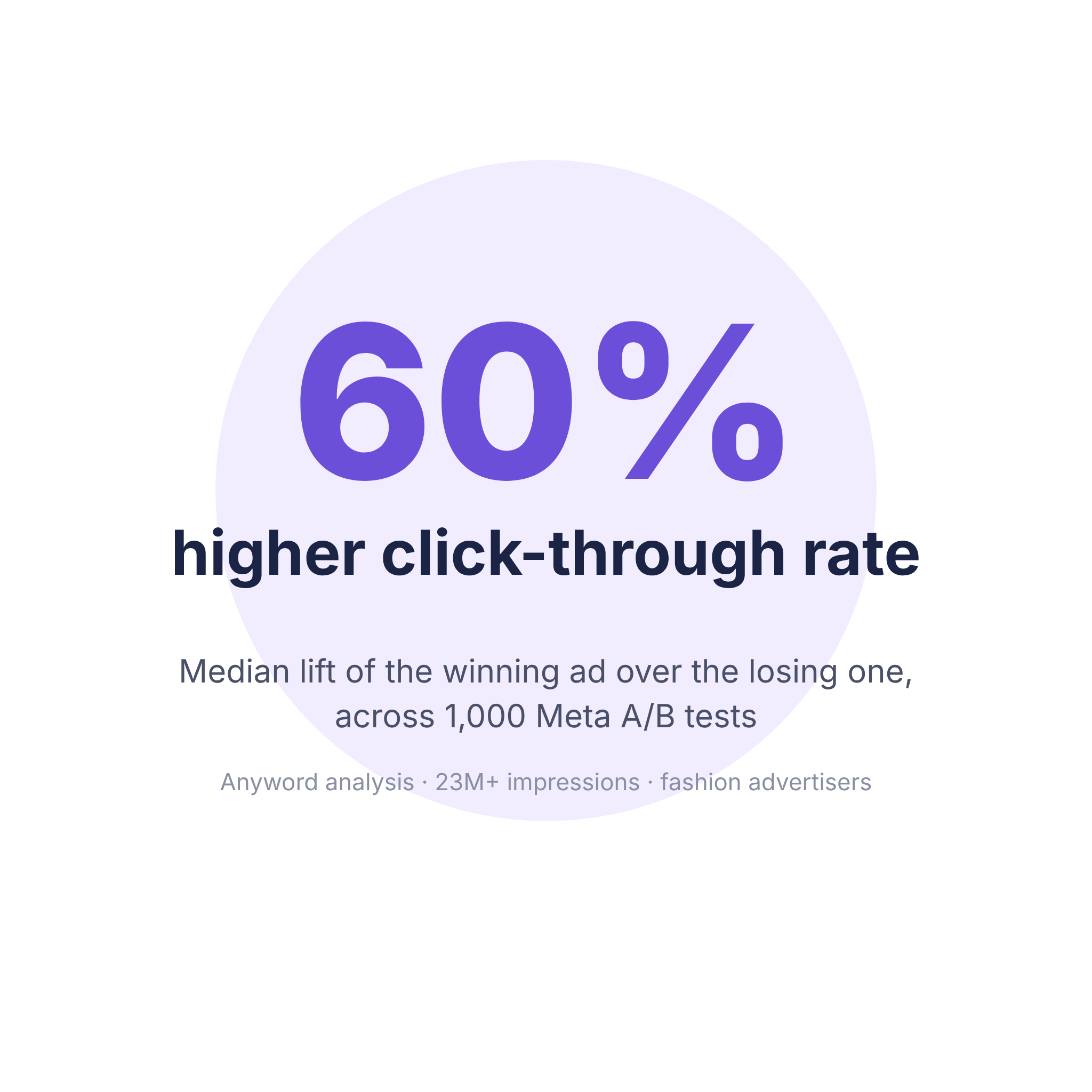
When we analyzed 1,000 real Meta A/B tests from fashion advertisers, covering five years and more than 23 million impressions, the winning version's click-through rate was a median of about 60% higher than the loser's. That gap is what you're leaving to chance when you skip pre-launch scoring.
A few patterns held up in headlines:
| Headline trait | How often it won |
|---|---|
| Conversational phrasing ("it's") | 88% |
| First person (I, my, we) | 81% |
| Includes a number | 69% |
| Generic filler ("stylish," "perfect," "chic") | 31% |
| Uses the word "review" | 7% |
But primary text showed almost no pattern. Length didn't matter, and only experience verbs like "tried" and "swear by" stood out, winning 66% of the time.
That's the lesson for anyone setting a Meta strategy: some copy decisions follow rules your team can learn, and some don't. Train folks on the stuff you know for sure, but for everything else, give them a way to predict before they spend, rather than just throw a bigger testing budget at them.
Every Meta program runs through four stages. The question for a marketing leader isn't whether each one uses AI. It's who owns each stage, and whether anyone owns the decisions in between:
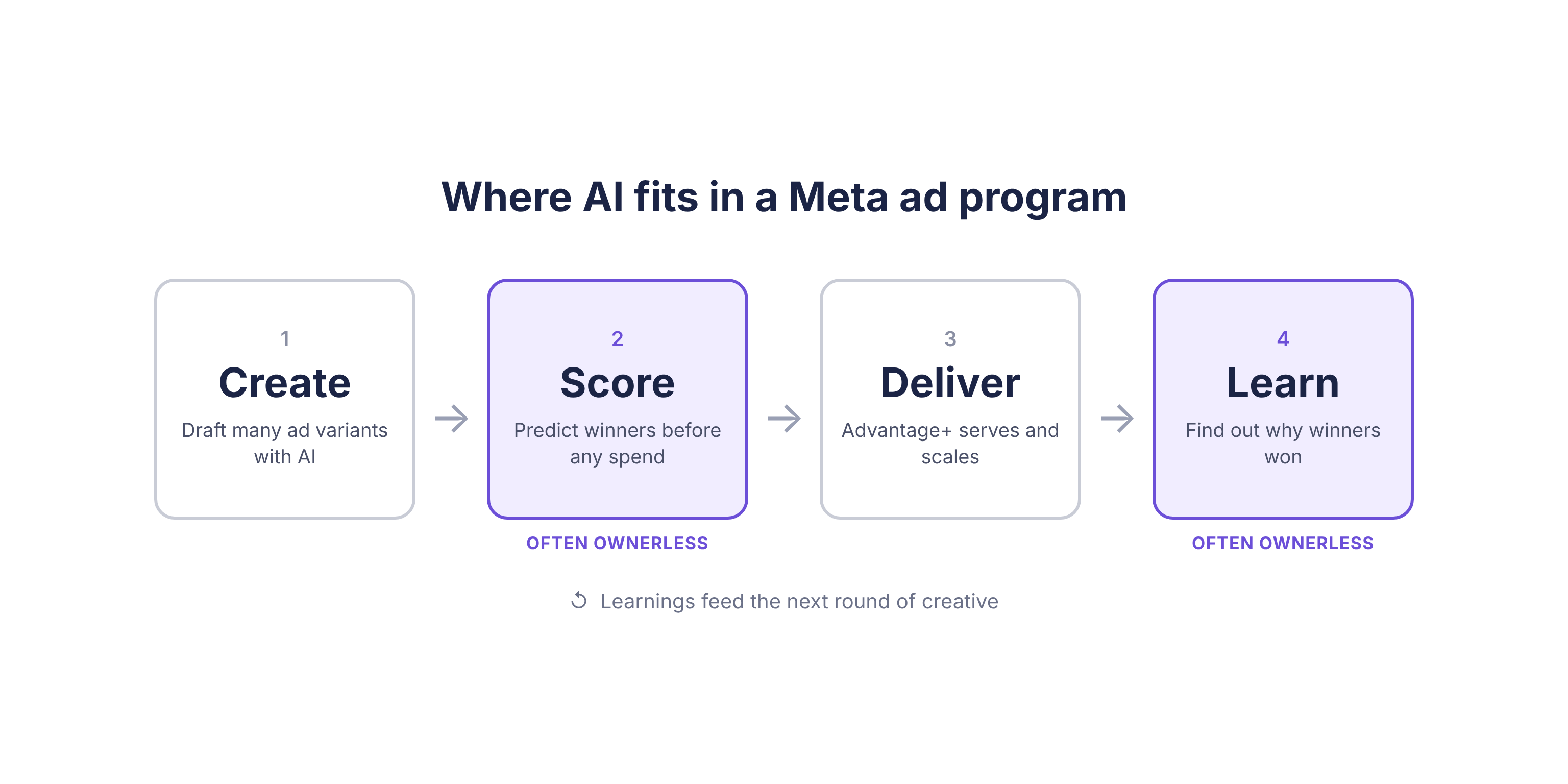
In most teams, stage 1 belongs to the copywriters and stage 3 belongs to Meta. Stages 2 and 4 can often end up ownerless. Decide who owns the scoring, and who will help take the learnings back to the broader team.
Advantage+ is built to find winners. But to find them, it has to serve the weaker variants first, measure them, and then shift budget away. That learning phase is paid for with your ad dollars.
We've called this the Black Box Tax: the platform optimizes, but you pay for every losing variant it tries along the way. And because the optimization happens inside Meta, your team rarely learns why one version beat another.
On most channels, a team decides what to test. On Meta, the platform decides, and it treats every variant you upload as a candidate worth paying to learn about. Upload ten weak ones and Advantage+ will dutifully find the least weak, on your budget.
The second cost is harder to see. The learning happens inside Meta, so your team gets a winner but rarely the reason. That makes it hard to carry the lesson anywhere else. (For the general math on what testing losers costs, see The ROI of Testing.)
You don't need to change how your team writes ads. What you need is someone directly responsible for ascertaining how stuff performs before it launches. Here's what an effective setup looks like:
From there, the habits that make testing pay off over time (a test log, shared learnings, a monthly recap) apply on Meta like anywhere else. We cover them in The ROI of Testing.
What to track as a leader:
| Metric | Why it matters on Meta |
|---|---|
| Share of variants scored before they entered Advantage+ | Tells you whether your setup is actually followed |
| Spend before a campaign exits the learning phase | The direct cost of Meta finding winners; should fall as inputs improve |
| Predicted vs. actual performance on launched variants | Tells you how much to trust the scores on your own account |
None of this replaces Meta's optimization, but it does change what Meta starts with -- namely, it enables the platform to hit the ground running.
"Best AI tool for Facebook ads" means different things depending on the job, and most teams need more than one. When you're deciding where to invest, map each tool to the stage it covers and the question it should answer:
| Tool type | Stage it covers | What it won't do | Question to ask before you buy |
|---|---|---|---|
| General AI assistants (ChatGPT, Claude, Copilot) | Create | Know your brand rules or predict performance | How does it stay on brand across everyone on the team? |
| Meta's built-in AI (Advantage+, dynamic creative) | Deliver | Tell you why a variant won, or fix weak creative | How much are we spending in the learning phase today? |
| Creative analytics tools | Learn | Help before you've spent anything | Can these insights reach channels beyond Meta? |
| Predictive scoring platforms (Anyword) | Score | Replace live testing entirely | How do predictions compare to actual results on our own ads? |
The stage most teams leave uncovered is scoring. (We're biased, obviously: Anyword's predictive scoring is built for exactly this step, and it sits on top of the assistants your team already uses rather than replacing them.)
In two places. Before launch, score creative so only the strongest variants get budget. After launch, let Advantage+ optimize delivery and make someone responsible for turning results into the next brief.
There isn't one tool for every stage. Most teams pair a drafting assistant with a predictive scoring tool and let Meta's AI handle delivery. Choose based on which stage your team leaves uncovered today.
Advantage+ is very good at delivery, but it learns by spending on every variant you give it, including weak ones. Pre-launch scoring lowers what you pay for that learning and gives your team insight it can reuse outside Meta.
They treat it as a process, not an end in itself. Teams generate many variants, cut them down with data before launch, let Meta's automation scale the winners, and review what won on a regular cadence.
Track the share of launched variants that were scored first, spend before campaigns exit the learning phase, and how closely predicted performance matches actual results on your own ads.
Yes. AI-written copy is still copy, and it has to earn its budget like anything else. See Can you even A/B test AI-generated content?
Want to know which version of your Meta ads will win before you spend on it? Book a demo of Anyword's predictive scoring.

Transform the way you do business with our AI writing tool. Sign up for free and explore our powerful tools.
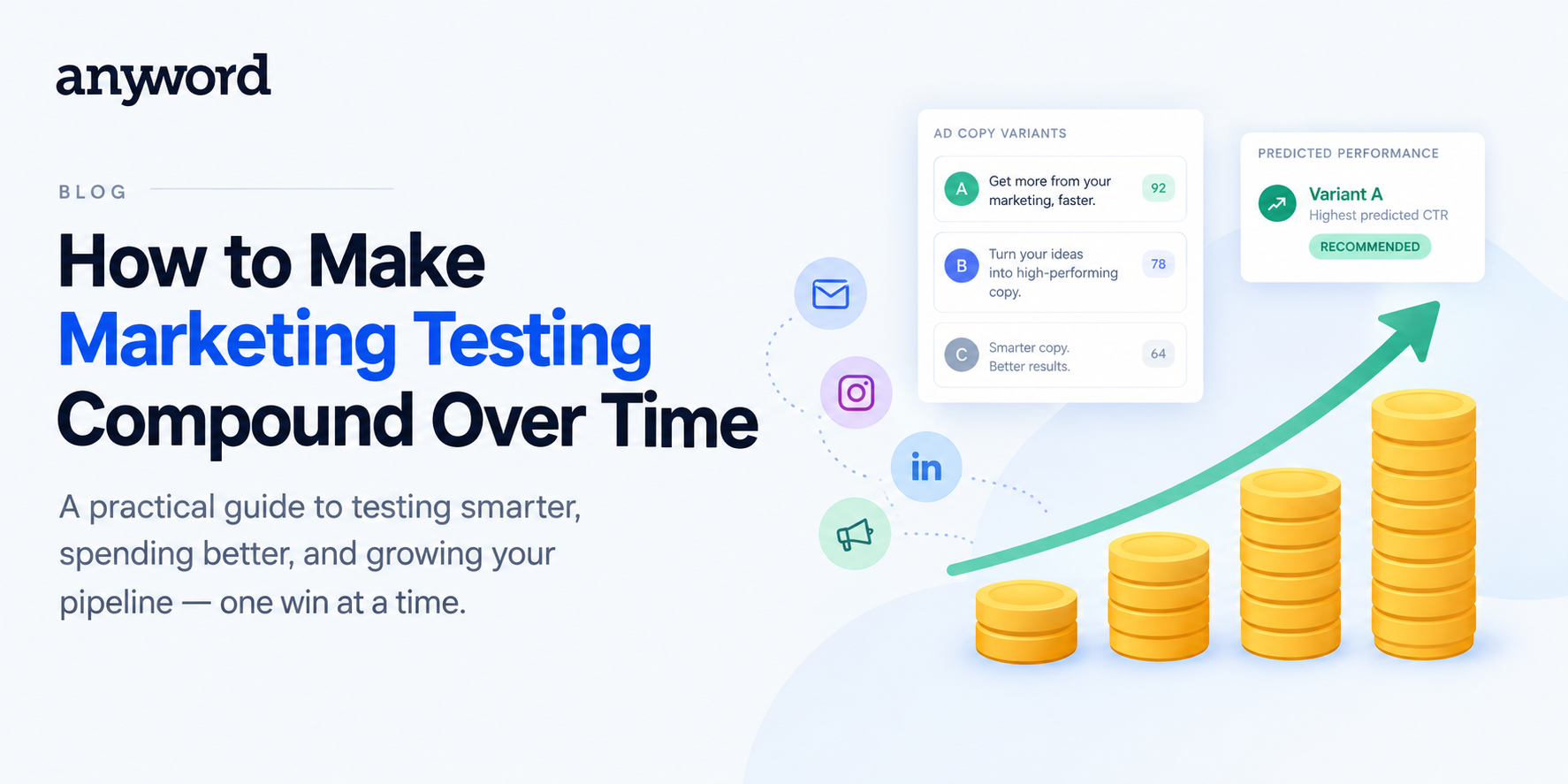
The best marketing team are the ones who have thoughtful testing process, who use their budget with fidelity, and who have an internal culture of continuous learning - and the right tools - that enables them to compound their ROI over time.
Every marketing team needs a solid testing practice, and one that doesn't drain time or budget. This quick guide covers email A/B testing best practices, plus practical tips to help you get better results, faster.